
Dry Needling in Canberra
Some muscle knots sit deep and stubborn, and no amount of thumb pressure quite shifts them. Dry needling is one of the treatments we offer for exactly that: a thin, sterile needle placed into a tight trigger point to help it let go. At our clinic it is performed by Colleen, our qualified massage therapist trained specifically in the technique, and it pairs naturally with hands-on massage.
Add it to any massage booking · (02) 6288 6711
What Is Dry Needling?
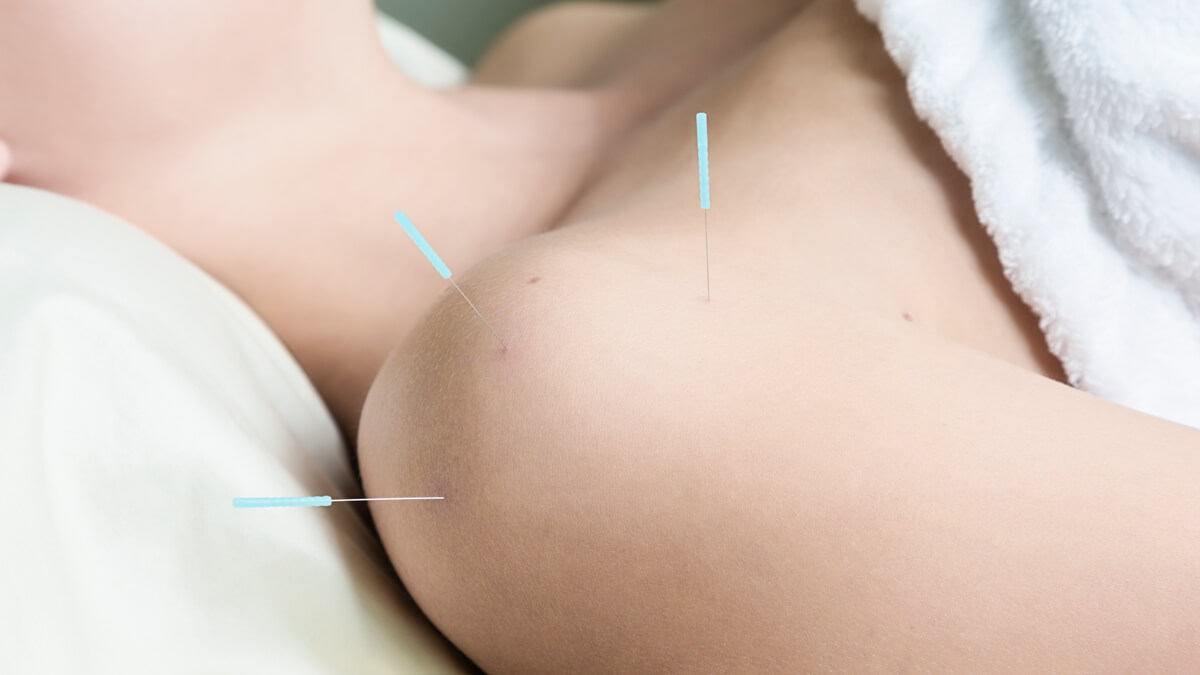
Dry needling is a treatment where a thin, sterile needle is inserted into a tight muscle knot, or trigger point, to help it release. At our clinic it is performed by Colleen, a qualified massage therapist trained specifically in the technique.
The name sounds more dramatic than the treatment is. The needle is called dry because, unlike an injection, nothing is delivered through it; there is no fluid, no medication, nothing but the fine needle itself. It is used to target what therapists call a trigger point, one of those tight, tender bands within a muscle that can ache locally and sometimes refer pain elsewhere. By placing a needle precisely into that spot, the aim is to prompt the muscle to release in a way that hands alone sometimes cannot achieve.
It helps to think of dry needling as a tool that sits alongside massage rather than a replacement for it. Colleen might spend most of a session working with her hands, then reach for needling on one or two knots that are proving stubborn, before returning to hands-on work to settle everything down. It is a targeted addition to a broader massage treatment, not a standalone mystery, and for the right muscle it can reach a little deeper and more specifically than pressure on its own.
Because it is a massage-therapy technique here, dry needling at our clinic is delivered by Colleen, who has completed specific training in it on top of her massage qualification. Our chiropractors do not perform needling; if it is something you are curious about, Colleen is the person to book with, and she is happy to talk you through whether it is likely to suit your particular problem before any needles come out.
If you have never come across dry needling before, you are far from alone; it has become much more common in Australian massage and physiotherapy over the last decade or so, but plenty of people still meet it for the first time when a therapist suggests it for a knot that will not shift. There is no expectation that you know anything about it walking in. Colleen will explain what she is proposing, why she thinks it might help, and exactly what it involves, and nothing happens until you are comfortable to go ahead.
How Does Dry Needling Release Trigger Points?
A trigger point is a small patch of muscle stuck in a shortened, contracted state. Placing a fine needle into it can prompt a brief involuntary twitch and encourage that patch to relax, easing the local tightness and often the referred ache that came with it.
To picture what a trigger point is, imagine a small section of a muscle that has clenched and simply forgotten how to let go. It stays contracted, tender to press, and can send a dull ache into nearby areas, which is why a knot between the shoulder blades can be felt as a headache or an ache down the arm. These stuck spots are a common part of ordinary muscle tightness, and they are exactly what dry needling is designed to target.
When a fine needle is placed accurately into one of these points, it often produces a quick, involuntary twitch of the muscle. That local twitch response is thought to be part of how the technique works, helping to reset the overactive, contracted patch so it can relax back to a more normal state. In plain terms, the muscle gets a small, precise prompt to release, and when it does, the local tightness and the referred ache it was driving tend to ease together.
Why a muscle gets stuck like this in the first place is usually no mystery. Long hours in one position, repetitive movements, a sudden overload, old habits of posture and plain everyday stress all encourage muscles to hold tension they never quite release. Over time a few spots become reliable troublemakers, the same knot in the same shoulder that flares whenever life gets busy. Needling gives those specific, repeat-offender spots a direct prompt to reset, which is why it can succeed where general pressure around the area has only ever brought temporary relief.
It is worth being honest that the exact science of trigger points and needling is still an area researchers are working through, and we would never overstate it. What we can say is that, used by a trained therapist on the right kind of muscular problem, many people experience a genuine and useful release. It is not magic and it is not a cure-all; it is a targeted way to help a stubborn muscle change its behaviour.
Dry Needling vs Acupuncture: The Real Difference
This is the question people ask most, usually because the two look similar from the outside. They do use similar fine needles, but the thinking behind them could hardly be more different, and understanding that clears up most of the confusion before you even step through the door.
Dry needling
- Based on modern Western anatomy and muscle science
- Targets specific trigger points in tight muscles
- Goal is to release a knot and ease muscular tension
- Delivered here by a trained massage therapist
- Usually a short, targeted part of a massage session
Acupuncture
- Rooted in Traditional Chinese Medicine, thousands of years old
- Uses points along meridians, or energy channels
- Goal framed around balancing the body's energy flow
- Practised by acupuncturists with their own training
- A complete therapy in its own right, not a massage add-on
The simplest way to hold the difference in your head is this: the needles may look alike, but they are being used to do two entirely separate jobs, guided by two entirely separate maps of the body. Dry needling reads a modern anatomy chart and aims at a specific tight muscle; acupuncture follows a traditional system of energy channels and points. Neither is a lesser version of the other. They are simply different practices that happen to share a tool.
People sometimes worry that choosing one means missing out on the other, but that is not really how it works. If your problem is a tight, knotted muscle, dry needling is the tool built for that job, and that is what we do here. If you are drawn to acupuncture as a broader therapy, that is a separate practice worth exploring on its own terms with a qualified acupuncturist. The two are not rivals so much as different answers to different questions, and neither of us would claim to be the other.
At our clinic, what we offer is dry needling, delivered from the massage-therapy side by Colleen as part of treating muscular tightness. We do not offer traditional acupuncture, and we are always careful not to blur the two, because they set out to do different things. If you would like the distinction explored more fully, our blog on needling vs acupuncture in depth lays it out in plain language.

What Does Dry Needling Feel Like?
The needle itself is so fine you often barely feel it go in. When it reaches a trigger point you may feel a brief, dull ache or a small muscle twitch, which passes quickly. Most people find it very manageable and oddly satisfying.
Nearly everyone arrives a little wary of the needles, which is completely understandable, so let us be plain about it. The needles used for dry needling are extremely thin, far finer than the ones used to take blood, and as they pass through the skin most people feel very little, sometimes nothing at all. It is a world away from an injection, and the anticipation is almost always worse than the reality.
The sensation people do notice comes when the needle reaches the trigger point itself. That can feel like a deep, dull ache, a cramp-like grab, or a quick involuntary twitch of the muscle, and while it is a strange feeling the first time, it is brief and most people describe it as oddly satisfying, the felt sense of a stubborn knot finally letting go. Colleen keeps you informed the whole way through and works within what is comfortable for you.
Afterwards, it is normal to feel a little muscle soreness in the treated area for a day or so, much like the tender feeling after a solid deep tissue massage. It settles on its own, and gentle movement and water help. If you would like more detail before you book, our blog on what needling feels like walks through it honestly, nerves and all.
What Conditions Respond Well to Dry Needling?
Dry needling may help with muscular problems driven by tight trigger points: a stiff, aching neck and shoulders, tension headaches from muscle tightness, sore backs and overworked sporting muscles. It works on the muscle, so muscle-based complaints respond best to it.
Dry needling is at its best when the problem is genuinely muscular. Tight, knotted muscles in the neck and shoulders are a classic example, especially the desk-bound tension that builds across the top of the shoulders and up into the base of the skull. When that tightness is driving a tension-type headache, releasing the trigger points behind it can bring welcome relief. It is a common reason people come in, and often a rewarding one to treat.
Beyond the neck and shoulders, it can help with a stiff, achy lower back where muscle tightness is a major part of the picture, and with the overworked muscles that come from sport and training, tight calves, cranky hips, forearms that have taken a hammering. If you carry a lot of general muscle tension treatment needs, and many people who work long hours at a desk certainly do, needling can be a useful extra string to the bow alongside regular hands-on massage. For a stubborn shoulder pain treatment case where a knot simply will not budge, it is often exactly the targeted nudge the muscle needs.
It also works well as a partner to other care rather than a lone fix. Someone having regular chiropractic care for their back might see Colleen for the tight muscles that keep flaring around a grumpy joint; a runner might use it on a stubborn calf between training blocks; a desk worker might reach for it when their usual massage is not quite touching a particular knot. In each case it is doing the same job, giving one specific, overworked muscle a targeted prompt to settle, as part of a bigger picture of keeping you moving well.
The honest boundary is this: dry needling treats muscles, not everything. It is not the answer for a problem coming from a joint, a nerve or something medical, and part of Colleen's job is to recognise when needling is not the right tool and to say so. If your issue turns out to be more about how a joint is moving, our chiropractors are right here, and you will be pointed toward whatever genuinely suits rather than sold a technique that was never going to help.
How Many Sessions Are Needed?
There is no fixed number. Some people feel a helpful change after one or two sessions; others use dry needling now and then alongside massage for ongoing tightness. Colleen will give you an honest sense of what to expect for your particular issue.
We are wary of any clinic that quotes you a set course of treatments before it has even met your muscles, so we will not do that here. How many sessions help depends entirely on the problem: a single, acute knot from an awkward week might ease noticeably after just one or two visits, while long-standing tightness that has been building for years tends to respond more gradually and may benefit from occasional top-ups as part of ongoing massage care.
What Colleen will do is give you a straight read after seeing how your body responds. If needling is clearly helping, she will say so and suggest a sensible rhythm; if it is not adding much beyond what hands-on massage is already achieving, she will say that too and steer you away from it. The goal is always to use the least you need to get a good result, not to book you in indefinitely.
Timing between sessions matters too, and Colleen will guide it. Because muscles are often a little tender for a day after needling, spacing treatments sensibly gives the tissue time to respond before it is worked again, rather than piling sessions on top of one another chasing a faster result. Slower and steadier usually wins here, and rushing rarely helps.
For a lot of people, dry needling ends up being an occasional tool rather than a standing appointment: something reached for when a particular knot flares up, used within a normal massage session, and then set aside until it is useful again. That flexible, as-needed approach tends to serve people better than any rigid package, and it keeps the treatment doing what it is good at without becoming a habit for its own sake.

Is Dry Needling Safe? Training and Hygiene Standards
In trained hands, dry needling is considered very safe. We use single-use, pre-sterilised needles that are disposed of immediately after each treatment, and Colleen has completed dedicated training in the technique on top of her massage qualification. Any minor after-effects, like brief soreness, settle quickly.
Safety in dry needling comes down to two things: clean needles and a properly trained practitioner, and we take both seriously. Every needle we use is single-use and pre-sterilised, taken from a sealed pack in front of you and disposed of straight into a clinical sharps container the moment the treatment is done. Nothing is ever reused, so the hygiene side is simply not something you need to think about.
Just as important is who is holding the needle. Dry needling is performed here only by Colleen, who has completed specific, recognised training in the technique in addition to her massage qualifications, and who treats within her professional scope. She knows the anatomy she is working around, which areas call for extra care, and when a muscle is not a suitable candidate for needling at all. That judgement is a large part of what makes it safe.
As with any treatment, there are a few sensible checks. Colleen will ask about your health and medications first, and there are some situations, certain medical conditions, being pregnant, or being needle-phobic to the point of real distress, where she may suggest that needling is not the right choice for you. That is exactly the kind of honest, careful conversation you should expect before anyone comes near you with a needle, and it is never a problem to change your mind or ask her to stop at any point.
Add Dry Needling to a Massage Booking with Colleen
Dry needling works best as part of a hands-on massage session, so the easiest way to try it is to book in with Colleen and mention you are interested. She will assess whether it suits your problem and talk you through it first. Book your session online, or have a chat with our team on (02) 6288 6711.
1/43 Brierly St, Weston ACT 2611 · upstairs beside Lava Cafe, parking opposite