
Chiropractic Care in Canberra
Chiropractic is the anchor of our chiropractic services and the reason this clinic has existed for more than five decades. On this page: what chiropractic care actually involves, what your first assessment looks like, the techniques Dr Samantha Teoh and Dr Timothy Porter work with, and the honest answers to the questions every new patient brings, including the ones about evidence, safety and visit numbers that other clinics prefer to dodge. Read it in four minutes and arrive at your first appointment already ahead.
Want to talk it through? Call (02) 6288 6711
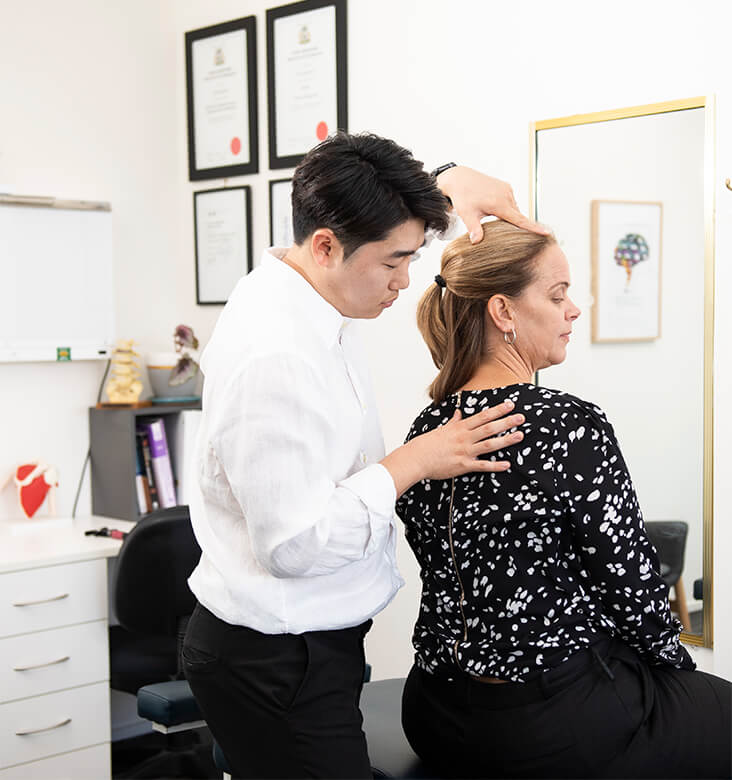
What Is Chiropractic Care?
Chiropractic care is the assessment, diagnosis and management of conditions affecting the spine, joints, muscles and nervous system, using precise manual and instrument techniques rather than medication or surgery. In Australia, chiropractors complete five years of university training and register with AHPRA.
Strip away decades of internet argument and chiropractic is a straightforward proposition: joints that move poorly change how everything around them behaves, from the muscles that guard them to the movements you unconsciously avoid. A chiropractor finds those restrictions through examination, restores motion with controlled techniques, and gives you the practical follow-up that stops the pattern reasserting itself the moment you sit back down at a desk. The word "care" earns its place in the name because the treatment is a plan across weeks, not a single dramatic fix on a Tuesday.
What it is not matters just as much here. Chiropractic at this practice is not a cure-all, not a substitute for your GP, and not a subscription you sign up to in perpetuity. It is one well-defined tool for a well-defined family of problems, applied by practitioners honest enough to say when it is the wrong tool. If you are still building a mental picture of the profession, our guide to what a chiropractor does walks through a working day in the rooms, patient by patient.
The training behind the title deserves a mention, because most patients underestimate it. An Australian chiropractor completes five years of accredited university study covering anatomy, physiology, neurology, diagnosis, radiology and hands-on technique, followed by registration requirements that continue for an entire career: annual continuing education, professional indemnity insurance, and a national register anyone can search. Dr Teoh added a full pharmacy degree on top of hers, and Dr Porter took his chiropractic degrees through Macquarie University's program. When we talk about assessment and diagnosis on this page, that is the education doing the talking.
What Happens at Your First Chiropractic Assessment?
Your first visit is a structured examination, not an on-the-spot adjustment. Expect a detailed history, physical and orthopaedic testing, a plain-language explanation of the findings, and a written plan with costs, before any treatment is agreed or delivered.
- The conversation. Your history, your symptoms, your work and sport, your medications, and what you actually want back, whether that is pain-free sleep or a return to the nets on Saturday. Expect real questions and unhurried answers; this part decides everything after it.
- The examination. Movement testing, orthopaedic and neurological screening where indicated, and hands-on assessment of the joints and muscles involved. Nothing is assumed from a questionnaire.
- The explanation. Findings in plain English, with your questions answered as they come up. If we recommend imaging first, or a different practitioner entirely, this is where you hear it.
- The plan. Recommended techniques, expected visit numbers, a scheduled review date and exact costs, agreed together before anything begins. Treatment often starts the same day when the examination supports it, and waits without pressure when it does not.
Bring your health fund card, any imaging reports or referral letters, a list of current medications and clothes you can move in. Dr Teoh's second qualification in pharmacy means that medication list gets genuinely read, not filed.
Children from age six, teenagers and every adult decade after are assessed with the same structure, scaled appropriately; parents stay in the room for younger patients and every step is explained before it happens.
If care does begin on day one, it is deliberately conservative: enough to start the process, never so much that a first-timer leaves overwhelmed or sore. Follow-up visits are shorter and more focused because the groundwork already exists, and your second appointment usually includes a quick check of how your body responded to the first, which tells us as much as any test. Mild, short-lived stiffness after early visits is common and normal; anything beyond that is something we want to hear about, and adjusting the plan in response is routine rather than remarkable.

Which Techniques Do Our Chiropractors Use?
Both chiropractors trained across several techniques precisely so no patient gets squeezed into a method that does not suit them. Your examination findings, your medications, your age and your preference decide the mix, and you can change your mind at any visit without anyone taking it personally.
Technique selection is also revisited, not set in stone at visit one. A plan might open with gentle mobilisation while an acute flare settles, graduate to adjusting once the region calms, and add soft tissue work when the muscles turn out to be half the story. The combination serving you in week one is often not the combination serving you in week six, and noticing that shift early is a large part of what your review appointments are for.
Manual adjustments
The classic hands-on technique: a precise, quick movement applied to a restricted joint, sometimes with the popping sound that gives chiropractic its reputation. The skill lies in the setup, positioning, direction and dosage, far more than the movement itself. Curious or nervous about that part? Read what happens during an adjustment before your visit; most apprehension does not survive the explanation.
Activator Methods instrument adjusting
A handheld instrument delivers a small, precisely measured impulse to one joint at a time, with no twisting and no cracking sound. Canberra has exactly two clinics offering Activator Methods and this is one, so the instrument carries much of our work with seniors, pregnant patients and anyone who prefers a lighter touch. Its dedicated page covers the technique, the research and the session experience in full.
Mobilisation and soft tissue work
Measured, gradual joint movement and hands-on muscle release for the patients and regions where adjusting is not the right call. Usually paired with rehabilitation advice and a couple of simple home exercises, so what improves on the table keeps improving between appointments.
Beyond the treatment room, every plan carries a self-care layer: the two or three exercises worth doing, the desk or lifting change that removes the daily re-injury, and honest guidance on heat, ice and activity. Patients who do the boring homework consistently need us less, and we consider that a feature of the service rather than a flaw in the business model. When muscle work needs more time than a chiropractic visit allows, the massage team down the corridor picks it up on the same shared file.
What Conditions Does Chiropractic Care Help With?
Chiropractic care helps manage back pain and sciatica, neck pain, headaches that begin in the neck, posture problems, muscle tension and general musculoskeletal injuries: the condition families belonging to the spine, joints, muscles and nervous system. Assessment confirms suitability before care ever starts.
That sentence is worded carefully, because Australian advertising rules for registered health professions demand it and because it happens to be the truth. We say "help manage" rather than promising cures, we name the condition families the evidence supports, and we treat the examination, not the marketing, as the gatekeeper for whether you become a patient.
In practice, the day list looks like this: lower backs that seized over the weekend, office necks feeding early-afternoon headaches, sciatic pain tracking down a leg, shoulders and hips that lost range somewhere in the last decade, and the general stiffness that makes gardens and grandchildren harder work than they used to be. The full library of conditions we help with gives each of these its own honest, detailed guide, including the red flags that send you to a GP before any table time.
The presentations also shift with age, and a practice that treats whole families sees the full arc. Teenagers arrive with sport and study postures, working adults with load and desk patterns, expecting mums with the week-by-week changes of pregnancy, and older patients with the mobility and balance questions that decide independence. The condition may share a name across those groups; the assessment, technique choice and goals rarely do, which is exactly why care here is written per person rather than per diagnosis.
Equally worth stating is what does not belong on that list. We do not treat, and do not claim to treat, non-musculoskeletal illness: infections, organ conditions, allergies, childhood developmental disorders or anything else outside the framework above. A clinic that promises less usually delivers more of it, and after fifty-plus years we are comfortable letting the narrower, truer claim do the selling.
Is Chiropractic Care Evidence-Based?
For the conditions we treat, yes. Spinal manipulation has clinical trial support for low back pain, neck pain and cervicogenic headache, and Australian clinical guidelines include it among recommended options. Where evidence is weak, we say so and do not offer the treatment.
Being evidence-based cuts both ways, and this practice accepts both edges. It means techniques earn their place in your plan from published research rather than tradition, and it equally means retiring claims the research does not carry. You will not find promises here about curing asthma, boosting immunity or treating anything beyond the musculoskeletal scope, because the evidence does not support them and the profession's regulator, sensibly, does not permit them.
Safety belongs in the same honest conversation. The research picture for modern chiropractic is reassuring: serious adverse events are rare, and the common side effects, mild soreness or stiffness for a day or so after early visits, are short-lived and predictable. Our screening exists to keep it that way; the history, the medication review and the choice of low-force techniques where age or bone health warrant them are all safety decisions made before the first adjustment, not after a problem.
What keeps the standard honest day to day is structure. Both chiropractors are registered through the Australian Health Practitioner Regulation Agency, complete mandatory continuing education every year, and write measurable goals into every care plan so progress is tested against something firmer than "how do you feel". When a plan is not moving those measures, the plan changes. That willingness to be wrong in small ways, quickly, is what evidence-based actually looks like from the patient side of the table.
For you as a patient, the practical translation is simple. You can ask "why this technique for my problem" at any point and receive an answer grounded in research rather than tradition. You can expect your progress to be measured in range, function and the activities you named at assessment, not just in reassurance. And you can trust that a treatment which stops earning its keep will be dropped from your plan before you have to raise it yourself.
How Many Visits Will You Need?
It depends on the problem, and anyone who quotes a number before examining you is guessing. As a guide: recent, simple problems often settle within a handful of visits, while long-standing conditions need longer management. Your plan states its expected visit count and review date up front.
Progress between visits counts too: the exercises done, the desk adjusted, the sleep improved all shorten the arc, and your chiropractor will say plainly when your own homework is doing more than the table time.
Watch for the two dishonest answers this question attracts elsewhere. One is the prepaid block of dozens of visits sold before your body has been examined, which treats a spine like a gym membership. The other is the vague "we'll see how you go" that never states a review date, because open-ended plans quietly become permanent ones. Both are absent here on principle.
Here is how the honest version works. After your assessment you receive a written recommendation with a specific number of visits and a scheduled review. At that review, three outcomes are on the table and all three get said out loud: finish because the goals are met, continue because the measures are improving, or change course because they are not. Nobody here is paid a bonus for visit volume, and discharge is treated as a success, not a lost customer.
Some patients, particularly those managing long-term conditions or physically punishing jobs, choose periodic maintenance visits after their initial plan ends. That is a legitimate choice when it is your choice; it is never a default setting, and declining it changes nothing about how you are treated when you next need us.
Cost tracks the same honesty. Every visit is priced individually, quoted before it happens and claimable through HICAPS where your extras cover includes chiropractic, with the full schedule published on our fees page. There are no bundles to buy and nothing prepaid, so the visit count in your plan is a clinical estimate, never a sales target.
To make the ranges concrete without promising anything: a recent, uncomplicated strain in an otherwise healthy adult commonly resolves across a small handful of closely spaced visits. A problem that has been rehearsing itself for years, a decade of desk posture, an old injury never properly addressed, typically needs a longer arc with visits spacing out as measures improve. And a small group of patients with degenerative or recurring conditions do best with ongoing periodic care, entered into with open eyes and reviewed like everything else. Your examination tells us which story yours is likely to be, and your plan says so in writing.
When Chiropractic Is Not the Answer: Our Referral Promise
Every clinical decision at this practice runs through one filter: is chiropractic genuinely the right tool for this person, today? When the answer is no, you hear it at the first visit, with a referral and a written summary for your GP, physiotherapist or specialist rather than a hopeful treatment plan. No examination fee has ever bought a diagnosis it did not deserve, and none ever will.
The examples are concrete. Signs suggesting fracture, infection or inflammatory disease go to medical care before anything else. Progressive weakness or numbness earns imaging and a specialist opinion, not an adjustment. A problem that is fundamentally a strength deficit belongs with structured rehabilitation, and we will name the profession better placed to run it. Even within our scope, if massage would serve you better than adjusting this month, your plan says so, and the therapist is thirty steps down the corridor.
Second opinions get the same open door. If you want your scan reviewed elsewhere, a GP's read on your plan, or simply time to think, you will get encouragement rather than pressure, and your records travel with you on request. Imaging itself follows the guidelines: we request X-rays or refer for scans when findings justify them, not as a routine welcome gift, because unnecessary imaging carries its own well-documented harms.
This is, frankly, why families have kept coming back since the 1970s. A clinic still standing after more than fifty years in the same small suburb has been audited by its own community for longer than most practitioners have been alive, and the verdict renews one honest referral at a time.

Book an Initial Assessment Online
Forty-five minutes, a proper examination and a plain-language plan with costs stated before treatment begins. Booking takes under a minute, and anything this page left unanswered is a quick call to (02) 6288 6711 away.
1/43 Brierly St, Weston ACT 2611 · Saturday mornings book out first