
Postnatal Chiropractic Care in Canberra
Recovery does not end at the birth. The endless feeding, lifting, rocking and carrying of new-parent life load a body that is still very much healing, and gentle care can help you feel more like yourself again. As one of our chiropractic services, postnatal chiropractic supports your back, neck and pelvic recovery with gentle techniques, honest advice, and, importantly, an open door for your baby to come along to every appointment.
Babies welcome in the room · (02) 6288 6711

When Can You See a Chiropractor After Birth?
There is no fixed rule; it depends on your birth and recovery. Many mums come once they feel ready to move about comfortably, often a few weeks after a straightforward birth. After a caesarean or a complicated delivery, we wait longer and coordinate with your GP. When in doubt, phone and we will advise honestly.
The honest answer respects that every birth and every recovery is different. After an uncomplicated vaginal birth, many mums feel ready for gentle care within a few weeks, once they are moving about reasonably comfortably and the immediate recovery has settled. There is no prize for rushing, and equally no need to suffer for months first; the right time is when discomfort is bothering you and your body has had a little space to begin healing.
After a caesarean, a difficult delivery, or any birth with complications, the timeline is longer and more cautious, and we take our cue from your medical team. Your six-week check with your GP is a sensible landmark, and we are glad to wait for it or to speak with your doctor if that helps. The guiding principle is simple, and we hold to it: gentle, appropriate, coordinated with your medical team where needed, and never rushed in before your body is genuinely ready for it. If you are unsure where you sit, a quick phone call before booking gets you a genuinely honest answer rather than a booking made simply for the sake of filling the diary.
It is worth saying plainly what postnatal chiropractic is and is not for, because the internet blurs it. This is care for the musculoskeletal aftermath of pregnancy and birth: the back, neck, shoulder and pelvic aches that come from a recovering body doing relentless physical work. It is not a treatment for medical complications of birth, for your baby's health, or for anything beyond the muscles and joints, and we make no claims in those directions. Your GP, maternal and child health nurse and, where relevant, a women's health physiotherapist remain central; we sit alongside them.
There is also no deadline. Some mums come at six weeks, some at six months, some when a toddler has been hoisted onto one hip a few thousand times and the back has finally objected. Postnatal recovery genuinely lasts far longer than the fortnight of maternity leave the world seems to imagine, and gentle care is useful across that whole span. Whenever the aches of parenting a small child are wearing you down, the door is open.
One caution worth stating gently: some postnatal symptoms are not for us at all, and knowing the difference is part of caring for you properly. Heavy or worsening bleeding, signs of infection, severe headache, chest pain, or the low mood and anxiety that can follow birth all belong with your GP or maternal health team, urgently where relevant, not with a chiropractor. We treat aching backs and tired shoulders; we are not, and would never pretend to be, the right first call for a genuine medical concern after birth. If something feels wrong beyond ordinary muscular ache, please contact your doctor.
Common Postnatal Complaints We Help With
New-parent life is physically relentless in ways the baby books gloss over. The same few complaints bring most mums through our door, and all of them respond well to gentle care combined with practical advice on how you feed, lift and carry.
Feeding and carrying posture
Hours hunched over a feeding baby, then a car seat, then a pram, then a toddler on one hip: the sustained forward-and-down posture of new parenthood loads the neck, upper back and shoulders relentlessly. Care eases the strain and we coach the setup changes that reduce it.
Upper back and neck strain
The tension headaches and stiff, burning shoulders that come from looking down all day and sleeping badly all night. Gentle work on the upper back and neck, plus honest advice on feeding position and phone habits, helps break the cycle.
Pelvic and lower back recovery
The pelvis and lower back carried the pregnancy and now do the lifting. Looser ligaments take months to firm up, so gentle care aims to restore even, comfortable movement while your body finishes recovering at its own pace.
None of these are treated with force. Postnatal bodies are still recovering, ligaments are still loose from pregnancy, and the whole approach stays gentle, low-force and led entirely by your comfort rather than by any fixed protocol. Where something falls outside our scope, pelvic floor concerns, for instance, which belong with a women's health physiotherapist, we say so and point you in the right direction.
If you recognise your own week in that list, you are experiencing something entirely normal and very common, not a sign that you are doing anything wrong. New parenthood is genuinely hard on a body, and a bit of gentle help with the physical side is a sensible thing to accept, not a weakness to push through.
A word specifically about the abdominal separation many mums ask about. A gap between the abdominal muscles, common after pregnancy, is real and worth addressing, but it is primarily managed with the right progressive exercise, usually guided by a women's health physiotherapist, rather than by chiropractic. We will happily flag it if we notice it, explain who is best placed to help, and treat the back and pelvic discomfort that often accompanies it, but we will not pretend adjusting is the answer to it. Honest scoping is part of good postnatal care.
Sleep, or the wholesale lack of it, deserves acknowledgement too, because it magnifies every ache on this list. We cannot give you more sleep, sadly, but we can make the many hours you are awake and upright a good deal more comfortable, and we deliberately factor the reality of broken nights into every single piece of advice we give. Telling a new parent to simply rest more is useless; working with the life you actually have is the only approach that helps.
Because of all this, the very first postnatal visit is a gentle, generous appointment rather than a brisk one. We take the time to hear how the birth went, how recovery is tracking and where the aches actually are, then examine carefully and explain what we find before suggesting anything. If gentle care looks likely to help, we start softly and build only as your body allows; if something should wait, or belongs with another practitioner, we say so. There is no pressure to commit to a plan of any kind, only an honest read on whether gentle care can realistically make your days a little more comfortable.
How Postnatal Care Differs From Regular Care
Postnatal care stays gentler for longer and works around the realities of new-parent life. Ligaments remain loose for months after birth, so we favour low-force techniques, shorter and more flexible appointments, and advice tailored to feeding, lifting and broken sleep rather than a standard treatment plan.
The clinical difference comes down to a body mid-recovery. The pregnancy hormone relaxin keeps ligaments loose for months after birth, especially while breastfeeding, which means the pelvis and spine are more mobile and need gentler handling than a non-postnatal body. Firm, forceful adjusting is rarely the right tool here; the low-force instrument and careful mobilisation do most of the work, exactly as they did during the pregnancy itself.
The human difference matters just as much. Care is built around a life that now runs on someone else's schedule: appointments kept flexible, plans that assume broken sleep and no spare time, advice that fits feeding and carrying rather than an idealised daily routine. And where the real fix is a change to how you feed or lift rather than another treatment, we will say so, because a small setup change you make twenty times a day beats anything we can do in a weekly appointment.
Those setup changes are genuinely the heart of it, and they are unglamorous in the best way. Bringing the baby up to the breast rather than curling down to the baby; supporting your arms and the baby's weight with pillows during feeds; alternating the hip you carry on; setting the change table to a height that does not fold you in half; getting the pram handle to a length that suits you rather than your partner. None of it is dramatic, all of it is repeated dozens of times daily, and small changes multiplied by that frequency add up to real relief.
Because the load is constant, the aim of care is realistic: to keep you comfortable and functional through a demanding season, not to deliver a single permanent fix that new-parent life would immediately undo anyway. That framing keeps expectations honest and the plan sensible. As your baby grows, sleeps a little better and needs slightly less constant carrying, the physical demands gradually ease, and most mums find they naturally need us less over time rather than more, which is exactly the trajectory that honest, well-run care should always follow. We would far rather see you happily discharged and getting on with life than booked in indefinitely, and we will tell you when that point has arrived.
Pairing Postnatal Chiropractic With Massage
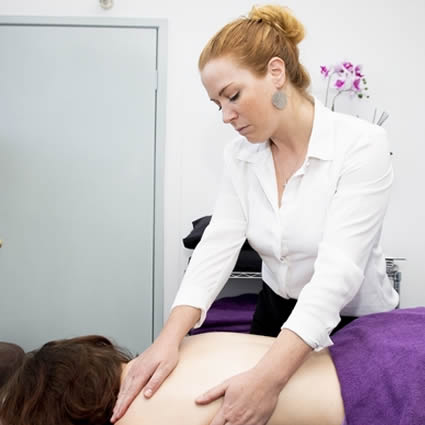
Postnatal chiropractic and massage complement each other under one roof and one patient record. Gentle joint care keeps the recovering pelvis and spine moving; hands-on massage releases the tired neck, shoulder and lower-back muscles that feeding and carrying punish daily. Searches for postnatal massage near me lead many mums to combine the two here.
If your search history includes postnatal massage near me, you are in good company; it is one of the most common ways new mums find us. Postnatal chiropractic builds naturally on the pregnancy chiropractic many mums received before the birth, and the muscles of new parenthood, the shoulders rounded over feeds, the lower back that lifts a growing baby dozens of times a day, respond beautifully to hands-on release, and pairing that with gentle joint care addresses both halves of the problem. The same therapists who deliver pregnancy and postnatal massage carry straight through from your pregnancy if you saw them then.
Because it is all one shared file, the two treatments are coordinated rather than duplicated, and the continuity from pregnancy into recovery is genuinely valuable when you have no spare energy to manage it. Your practitioners already know your history, your birth and your preferences, so nothing needs re-explaining at a moment when re-explaining anything feels like a chore. Many mums simply continue the rhythm they found during pregnancy, adjusting the mix as recovery progresses, and let the practice handle the coordination.
The practicalities are kept as easy as the care is kept gentle. Free parking sits directly opposite the door, which matters enormously when you are wrangling a capsule and a nappy bag; the building is pram-friendly; and Saturday mornings mean a partner can come along to help, or the appointment can happen without stealing a weekday you do not have to spare. Handling both your joint care and your muscle care in a single visit, under one roof, quietly removes the kind of double-booking logistics that feel impossible with a newborn in the mix.
For a fuller picture of what recovery looks like beyond the treatment room, our postnatal recovery guide covers the self-care, pacing and realistic timelines in more depth. It is written for tired parents rather than for textbooks, and you can read the whole thing in the small hours when the baby is finally down and you are lying there wondering whether the ache in your back is normal or something to worry about. Usually it is, and usually there is something simple that helps, which is a reassuring thing to read at three in the morning.
Bringing Baby to Your Appointment
Bring your baby; they are genuinely welcome in the treatment room. There is space for a pram or capsule, you can feed or settle them if needed, and our practitioners are used to working around a baby's schedule. Finding childcare is one barrier to your own recovery we are happy to remove.
For a lot of new mums, the single thing standing between them and their own care is the impossibility of arranging childcare for an hour. So we removed it. Your baby comes with you, full stop. There is room for the pram or capsule beside the treatment table, you are welcome to feed or settle them mid-appointment, and nobody here is fazed by a bit of noise; we have been doing this for decades and a crying baby is simply part of the room.
Practically, it just works. If your baby needs feeding, we pause; if they settle and sleep, we carry on; if it all gets chaotic, we simply go with it and still get plenty of useful care done in the calmer stretches. Bring whatever you need for them, and do not give the mess or the interruptions a second thought. Prioritising your own recovery is not a luxury or a self-indulgence, it is what lets you keep doing the enormous physical job of caring for them, and bringing them along is simply how we make that possible.
Partners, older siblings and support people are welcome too, so if a solo trip with a newborn feels daunting, bring reinforcements. The room accommodates a bit of family, and an extra pair of hands to hold the baby while you have your appointment is entirely fine by us. Whatever configuration gets you through the door and onto the table is the right one; we are flexible because new-parent life demands it. A short list helps some parents feel prepared: pack the usual nappy bag, feel free to feed on arrival if that settles things, and do not stress about timing the visit perfectly around naps, because we will simply work around whatever your baby decides to do that day.
This welcome is not a special accommodation grudgingly made, it is simply who this practice is. A clinic that has looked after Canberra families for more than fifty years has seen every possible version of a mum arriving with a baby in tow, and treats a mum arriving with a newborn as completely ordinary, because in this practice it genuinely is. You will certainly not be the first parent to feed mid-appointment or to apologise, needlessly, for a crying baby, and you will be gently told, as everyone is, that there is absolutely nothing to apologise for.
There is a quiet privilege, too, in caring for families across the whole arc: the same practice that eased a pregnancy now supports the recovery, and in time may look after the growing child and the ageing grandparents as well. That continuity is not a marketing line; it is genuinely how many local families use us, generation into generation, and it starts with something as simple as a tired new mum deciding her own recovery is worth an hour, baby and all.

Book Postnatal Care; Babies Welcome in the Treatment Room
Recovery deserves its own appointment, and your baby is welcome to come along to it. Booking is quick online, and the team on (02) 6288 6711 can advise on timing after your particular birth if you are unsure.
1/43 Brierly St, Weston ACT 2611 · pram-friendly, free parking opposite